
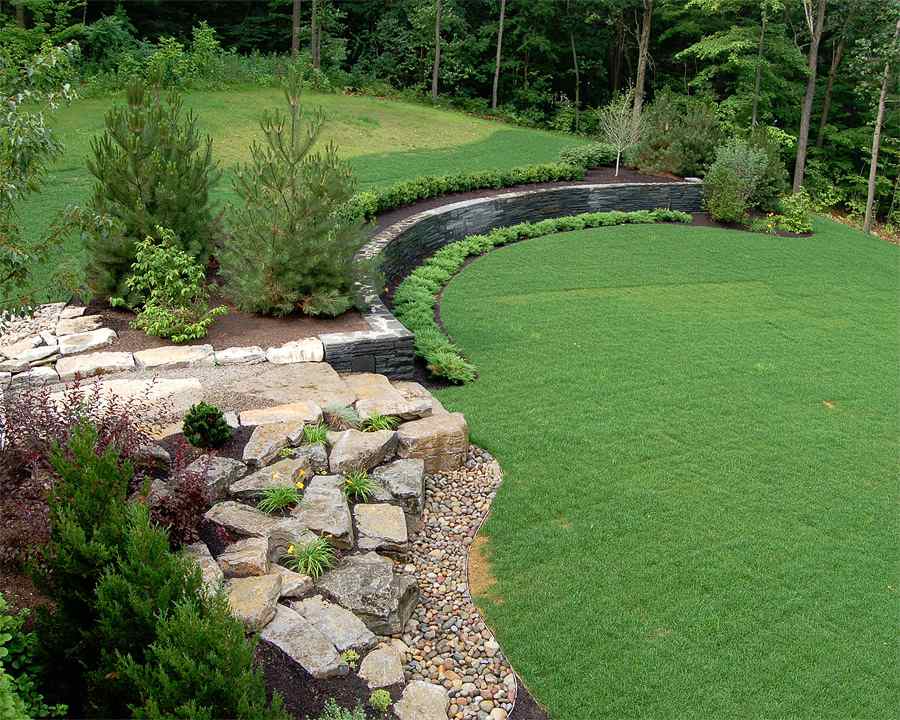
A sloped property can be one of the most challenging parts of a landscape, but it can also become one of the most beautiful and functional areas of a home. For many homeowners in Saratoga County and across upstate New York, sloped yards create familiar problems: water moving too quickly downhill, soil washing away after heavy rain, lawn areas that are difficult to mow, and backyard space that feels too steep to use comfortably.
These issues are especially important in this region, where spring snowmelt, heavy seasonal rain, and freeze-thaw cycles can put extra pressure on soil, planting areas, hardscapes, and drainage systems. Without the right plan, a slope can lead to erosion, standing water, damaged lawn areas, unstable planting beds, and runoff that moves toward patios, walkways, driveways, or even the home’s foundation.
The right landscape design can change that. A sloped yard does not have to be wasted space. For homeowners searching for landscaping for sloped yard challenges in Saratoga County, the right plan starts with understanding how water, soil, access, and outdoor living all work together. With thoughtful grading, drainage, retaining walls, hardscaping, planting, and outdoor living features, a difficult slope can become a usable and visually interesting part of the property.
At Peak Environmental, the Design-Build Process looks at the whole site, how the land moves, where water flows, how the property is used, and how the space can support long-term outdoor living.
Understand What the Slope Is Doing
Before choosing a landscape solution, it is important to understand the role the slope plays on the property. A sloped yard is not just a visual concern. It affects drainage, access, maintenance, soil stability, and how comfortable the space feels for everyday use.
Some sloped properties lose soil during storms. Others collect water in low areas. Some are too steep for a patio, play area, or seating space. In many cases, the issue is a combination of all three: water moves too quickly, soil becomes unstable, and the backyard feels disconnected from the rest of the home.
Common slope-related problems include:
- Erosion, when soil washes downhill during rain or snowmelt
- Poor drainage, when water collects in low spots or moves toward structures
- Unusable backyard space, when the grade is too steep for seating, dining, or play
- Difficult mowing, especially on turf areas that are steep or uneven
- Awkward transitions, where it is hard to move safely between different levels of the yard
A successful design starts by solving these functional problems first. The best backyard slope solutions usually combine drainage, access, structure, planting, and long-term maintenance planning. Once those elements are addressed, the slope can become a natural design feature instead of a constant maintenance issue.
Start With Drainage and Erosion Control
On a sloped property, drainage is not an afterthought. It is the foundation of the design. If water is not managed correctly, even a beautiful patio, walkway, planting bed, or retaining wall can develop problems over time.
Peak’s drainage systems, water management and erosion control services are especially relevant for sloped yards because they focus on moving water away from areas where it can cause damage. Depending on the property, drainage solutions may include grading, French drains, dry wells, leader drains, porous pavements, or dry river beds.
A dry river bed, for example, can guide stormwater through the landscape while also adding stone, texture, and a natural visual element. Porous pavement may help reduce standing water in hardscape areas. French drains can redirect excess water below the surface. The best solution depends on how water currently moves across the property and where it needs to go.
For homeowners in Saratoga County, this step is especially important because seasonal water movement can be significant. A slope that seems manageable in dry weather may behave very differently during a heavy storm or spring thaw.
Use Retaining Walls to Create Level Space
Retaining walls are one of the most effective landscaping options for a sloped property. They help hold soil in place, reduce erosion, and create flat areas that homeowners can actually use.
Peak’s retaining wall contractor services can help turn a steep grade into a more organized landscape. A retaining wall might support a patio, frame a planting bed, define a walkway, or divide a backyard into multiple usable levels.
Instead of treating the slope as one difficult area, retaining walls can break the yard into more manageable spaces. For example, a sloped backyard might be designed with an upper dining patio near the home, a middle terrace with layered planting, and a lower firepit or seating area. Stone steps or walkways can connect each level so the yard feels intentional rather than disconnected.
The goal is not to fight the slope. The goal is to shape it into something useful, stable, and attractive.
Build Terraces, Patios, and Outdoor Living Areas
One advantage of a sloped property is that it naturally creates different levels. With the right design, those levels can become separate outdoor rooms.
Peak’s outdoor living spaces services can help transform a steep backyard into a connected environment for dining, relaxing, cooking, and entertaining. Rather than forcing one large flat space into the yard, the design can work with the natural grade.
A sloped property may include:
- A patio close to the home for outdoor dining
- Stone steps leading through planted terraces
- A firepit area set into a lower section of the yard
- Seating walls that define gathering areas
- Lighting that improves safety and extends use after dark
- A pergola or pavilion that adds shade and structure
Features like patios, pergolas, pavilions and fences can help connect the home to the landscape while making the slope feel like part of the overall outdoor living plan.
This is where a difficult backyard can become a major asset. Elevation changes can create views, privacy, movement, and a stronger sense of destination within the landscape.
Stabilize the Slope With Plantings
Not every slope needs a wall. In many cases, plantings are one of the best ways to stabilize a sloped area, soften hardscape features, and reduce maintenance.
Exposed soil is more vulnerable to erosion. Layered planting can help slow runoff, cover bare ground, and make the slope look intentional throughout the season. Groundcovers, ornamental grasses, shrubs, perennials, and native plants can all play a role depending on the site conditions.
Plantings are especially useful in areas that are too steep or inconvenient to mow. Instead of struggling to maintain turf on a difficult grade, homeowners can use planting beds to create a more natural and lower-maintenance slope.
Peak’s Eco-Friendly Property Transformations can support this kind of approach by focusing on long-term landscape health, sustainable design choices, and solutions that work with the property rather than against it.
Make the Slope Easier to Maintain
A sloped yard should not become a constant maintenance burden. A good design should make the property easier to care for over time.
That may mean reducing turf in steep areas, adding stable walkways, improving drainage, choosing durable hardscape materials, and using plants that fit the conditions of the site. It may also mean thinking carefully about how the space will be maintained after installation.
Peak’s Greencare approach is relevant here because maintenance should be part of the planning conversation, not something considered only after the project is complete. For some properties, robotic mowing may be appropriate where the grade and layout allow. For others, the better solution may be replacing hard-to-mow lawn with planting beds, terraces, or hardscape areas.
The best sloped-yard designs are not only attractive when they are installed. They continue to function as the landscape matures.
A Sloped Yard Can Become the Best Part of the Property
A slope does not have to mean wasted space. With the right combination of drainage, erosion control, retaining walls, patios, walkways, plantings, and outdoor living features, a challenging grade can become one of the most useful and beautiful parts of the property.
For homeowners in Saratoga County and throughout upstate New York, a sloped yard can become more than a problem to solve. It can become a landscape that works with the natural grade instead of against it, creating safer access, better water management, stronger outdoor living areas, and a more beautiful property overall.
If your sloped yard feels difficult to use, maintain, or protect from erosion, Peak Environmental can help turn it into a stable, usable, and thoughtfully designed outdoor space built for long-term performance.